The River
A strategy for industrial-scale sourcing and kitting automation for LEGO
Spencer Hubert ·
There is close to a trillion pounds of bulk LEGO sitting around in the world right now. It is effectively worthless, the owners don't know what to do with it. The bricks are fine, but while most people refuse to throw away LEGO because it feels like sacrilege, they don't want to play with a giant box of jumbled up pieces. They want sets, so they buy new LEGO in the form of complete sets, which eventually find their way into the jumbled box too.
In my opinion, few consumers care that the LEGO logo is on the box, or whether the bricks are "new" or "used." What they want is a set representing a thing they know and like, with high quality instructions and high quality bricks.
LEGO sold these bricks once. Maybe they've been sold again a few times since. But say you were to sell the entire trillion pounds at the same rate TLG sold them at. We'll assume a pound of LEGO is about 350 pieces. A typical set is a few hundred pieces, and at retail LEGO works out to about 10 cents per part. At 10 cents a part, a pound of LEGO is about $35, and a trillion pounds is around $35 trillion (with very large margins of error).
LEGO made $35 trillion off these bricks. Why can't you? What's different between you and LEGO? I don't think the answer is simply the price of the bricks. Yes, LEGO gets their own pieces at cost, but at scale BrickLinkers are also sourcing near cost. The problem is, the pieces are completely jumbled up! It's the automated industrial capacity around them to turn them into sets that makes LEGO's more affordable than, say, Brickmania. Sure, professional BrickLinkers can source bulk LEGO for extremely cheap prices, but even at a relatively small scale, the logistics to handle it is very complicated. And on top of that, it's exponentially difficult to scale such an operation. Picking speed goes up and each employee is more difficult to find than the last.
We're working on Sorter, a LEGO sorting machine. It's getting better every day, and we're designing it with the intention to make thousands. It can sort LEGO, pretty well too, but one step inside a real BrickLink store will show you that sorting is at most 50% of the work involved before we've made money off the bricks again, by say, shipping an order or selling a custom kit.
The worst part about sorting is that you have to store the results of your sort somewhere. You don't want to undo all your work, so you have to put them into bags, or carefully categorized and labeled boxes, so that when somebody actually orders that piece, maybe years after you sorted it, you can pull it in a few minutes.
What if we didn't sort at all? Let's just ruminate on a strategy that might work to seize $35 trillion in LEGO bricks. The following is a concept to build industrial capacity for sorting and kitting automation competitive with LEGO themselves.
There's no shortage of bricks or demand for the bricks
As of 2023, the aftermarket is about 6% of the LEGO-related market, somewhere around $700 million. The reason it's that small is a total bottleneck on its ability to source parts and then deal with those parts automatically. The aftermarket is fighting against LEGO, who has massive amounts of automation on their side to turn bricks that are effectively free to them into products.
The initial assumption is that LEGO bricks are effectively free for LEGO and expensive for everyone else. In truth, I think bulk LEGO, just raw bricks, is basically free for BrickLink sellers too, once they get into the groove of things. Once a seller knows what they're doing, they can source arbitrary amounts, shipping containers' worth, with ease. The world is narrowing in on a trillion pounds of unsorted LEGO out there. Most of it is not in the trash, but to the people who own it, it's effectively useless. It's not garbage, because we all recognize that it feels like sacrilege to get rid of LEGO, but they can do nothing with it.
So the bricks themselves are roughly the same cost, at least the same order of magnitude of price. What's expensive is dealing with them, and that's where the aftermarket gets stuck. The bricks aren't sorted by any means. Inside the LEGO factory, every brick is perfectly sorted, because it just came out of an injection molding machine that only makes one type of part. Nobody does that for you on the aftermarket. And the handling isn't automated either. Whether you're selling parts on BrickLink or building individual kits, you have to hire people to do this, and it's logistically very difficult. You can't arbitrarily scale horizontally; you can't just invest more money and scale bigger. Scaling gets more complicated as you go up, because you have a bigger team, a bigger space, and the time it takes to pick a part goes up exponentially. If you're making a kit, the number of unique molds and colors in that kit makes the complexity of building it go up exponentially.
This is why third-party LEGO kits are so expensive. I don't know what their margins actually are, but I don't imagine they're extremely high. I think it's just extremely expensive to create them, because there's very little source available for LEGO and it's difficult to deal with after the fact.
You can't hire your way out of this
It's worth sitting on the scaling problem, because it's the real wall. There's currently no lever you can pull to arbitrarily scale up a BrickLink or LEGO aftermarket operation. Every incremental step is painful, and maybe even more painful than the last, because of these exponential complexities. Picking gets more complicated, the facilities get larger, the job gets harder for each person, training gets harder, and so on.
People think a LEGO sorting machine replaces a person. The obvious retort is that the person is paid, but they usually aren't, at least not hourly. It might be a nephew doing it for free, or someone paid per bin. The fastest people can sort a 27-gallon bin in a day; the slowest take four months. The machine might theoretically replace or relieve those people, but I don't want to frame this as replacing anyone. Call it supplementing them.
The bigger issue is that you can't hire these people in the first place. The labor is simply not available for the LEGO sorting job. It isn't high-return enough, it isn't stimulating, and it's still relatively complicated. There are over 200 different LEGO molds, and sorting them into a few dozen to a few hundred categories is difficult and extremely menial, days of slow but dexterous effort. Nobody really wants to do it, especially not for the price it would be worth. And LEGO aftermarket items are already overpriced. Brickmania kits are twice the price they'd prefer to be in order to compete with LEGO, so the price of LEGO is already too high. You can't pay these people more than we already do.
So regardless of the economics, which are secondary anyway, the main thing is this: the personality type to do the job is rare and hard to find. That's probably the first thing that stops people from scaling any further. Each incremental hire is very hard to find, and you can't flip a lever to go find them. On top of that, the economics mean it can only ever pay so well.
A machine is different. You can simply buy more of them and set them up. And as the machine becomes more resilient, it requires less human interaction. In the midgame of Sorter, which is where we are now, the average time between human intervention is probably about two hours, and that's going to become 12, and eventually well past that. What that means is that one person can manage more and more machines over time. It's also a more stimulating job than just sorting, so I think it's easier to find people to do it.
Brickmania, and what people actually want
One of the most famous custom LEGO kit businesses is Brickmania. They dominate the one market segment LEGO will never touch, which is military, and they make very well-designed, premium kits. But one thing every BrickLinker knows is that everybody gets orders from Brickmania. It doesn't matter how big or small your store is. If you list dark bluish gray pieces they need for an upcoming kit, you will get an order, because they have to source from everywhere they can find parts.
And their kits sell out. As far as I can tell from the outside, they have as much demand as they can meet, and the kits are expensive purely for logistical reasons. The day a kit like that becomes competitive with LEGO's own pricing, you best believe that demand is going to go through the roof.
And it's worth being clear about what that demand actually is. Normal people don't want a box with the LEGO logo on it. They want a brick-built kit of something they know, that's cool and goes together well, made with quality bricks that aren't necessarily real LEGO. They don't care whether the pieces are new or used. There are levels to being a used piece. They care that the kit looks right, that the instructions are well made, that all the pieces are there. That's what they actually care about.
The real problem isn't sorting, it's what comes after
There's something ironic about a sorting machine: the form factor isn't actually well optimized for sorting. If what you want is perfect granularity, one bin for every mold-color, the machine isn't well suited to it. But that's fine, because sorting into perfect bins was never really the goal.
Here's the thing a BrickLink store actually runs into: you don't necessarily need a massive amount of pieces sorted, because what do you do with them once they're sorted? You have to put them into containers that are easy to pick from, and that's really hard. You end up with a lot of redundant containers, then you go through a phase of consolidation, and then you have to make it logistically efficient for people to go find the parts, on a very short time horizon.
So how do you automate that part? How do you turn the sorting machine into a picking machine?
The answer is that you somehow need to be sifting through the pieces that are inside your orders. Say your store got 10 orders today. Imagine that at the end of the day you could take a box you had complete confidence contained 100% of the parts across all of those orders. You could simply put that box into the machine and pull the pieces out into bins, except instead of sorting by category, you're sorting by order. You can sort by order.
This is why the actual superpower of sorting comes not from sorting but from catalog. What you want is to be able to catalog pieces at massive scale, put them into boxes, and know which boxes to pull back out and put through the machine strategically. This is how you turn a shipping container of LEGO not into a bunch of stack-ons, but into something people can actually buy from.
Hot and cold storage
There's a concept here of hot and cold storage. Hot storage is pieces you can order today and fill tomorrow. Cold storage is pieces that could take, say, up to three months to fill. We'd need to do the math to figure out what that number actually is, but let's say three months.
The end result looks like going to Brickmania and saying: "Here's what I have in my cold storage, which is a hundred times bigger than my hot storage. What kits are you working on? I can get you unbelievable quantities of that part over the next three months." This would be a special site, with a minimum order of around $5,000. And it would double as a catalog for Brickmania to reliably build kits around, designing the kits around these parts, in a way where they know they can source them at whatever quantity the demand asks for.
The river
So once you have a hundred orders from various people, you slowly, over the coming months, begin sifting through the boxes in the shipping container. Ideally there's already been some strategic allocation of parts into those boxes, some phase of consolidation that the machine has already done, because the machine sorts when it catalogs. You could set it up to work this way.
Worth mentioning separately: you could also build custom machines specific just for cataloging. Put a bunch of pieces onto a conveyor belt, use object tracking to locate them, classify them individually, and put them back into the box. You could catalog thousands of pieces at a time, at hundreds to thousands of times the speed of running them through the sorting machine, and put them right back. That could be the first thing you do. Then you have the box, and you can choose which ones to consolidate, or simply put those boxes back through the machine and siphon parts out over the coming weeks.
Every machine would have a box called Brickmania. After three months, you have a big crate full of only the parts Brickmania wanted.
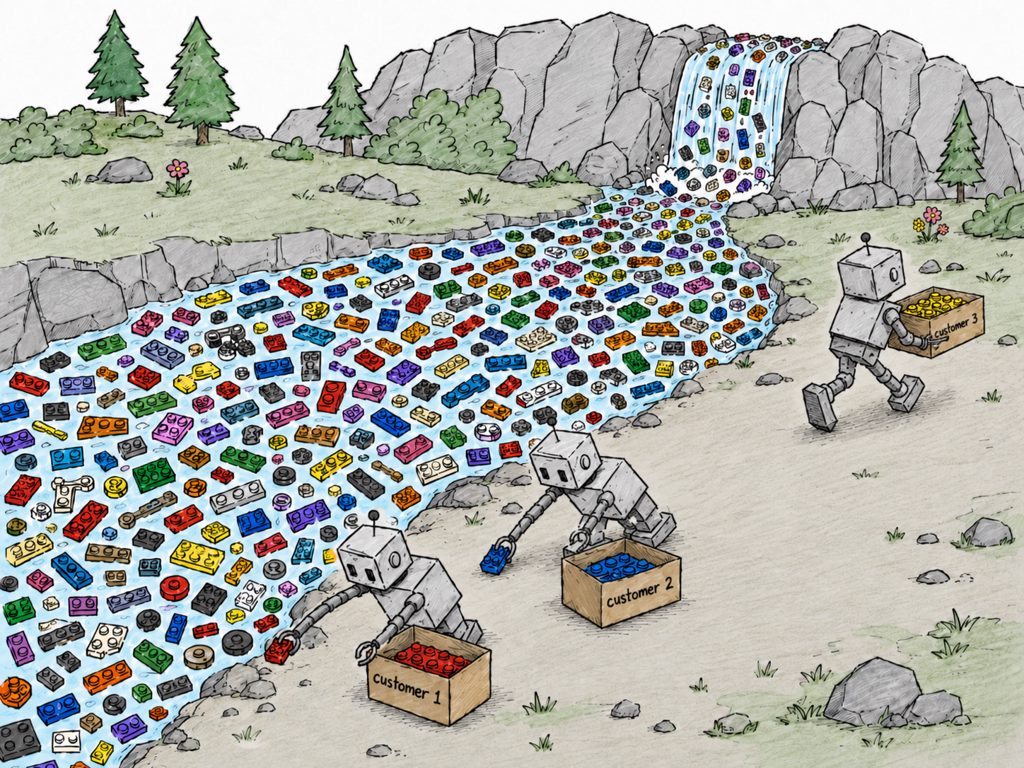
This is the river. The river is the constant sifting through of parts. It's a river of LEGO that's always moving, and the machine can step in, grab a part, and put it in a box for Brickmania or for a customer. At the end of the day, you have a box that's ready to ship, not a box that's ready for more work.
Ready to go, or more work
Because that's the real distinction. The machine either produces a box that's ready to go or a box that requires more work.
The naive approach outputs a box that still requires more work. You have to hand it to somebody to verify its contents, or put the pieces into a stack-on drawer or something like that. And eventually, somewhere down the line, more work gets created when somebody actually orders those parts and they have to be pulled. So there could be multiple hours of work associated with that box after it's "finished" in the machine. The better happy path is that the box is ready to go, ready to be zipped up into a bag and sent out to a customer.
Kitting is the clearest example. If you're running pieces through the machine and assembling custom sets, or orders, or regular LEGO sets, those things are ready to be bagged up and sent to customers, especially if you can set the expectation with the customer that says, "hey, this was sorted by a machine." The reason it's cheap is that we don't have humans verifying the quality. We believe these are 95% accurate. This is what LEGO already does with LUG bulk: there's a margin of error that's acceptable, the customer agrees to that margin of error, and that's why LUG bulk is very cheap.
How much scale is enough scale
It's worth grounding this in numbers, because the scale of the opportunity is strange. Sorter currently processes about 6 parts per minute. I think it gets to 30 on the current hardware eventually, so call it a 5x improvement, and let's run both. Assume a machine runs 24/7 and that a pound of LEGO is about 350 pieces. At 6 parts per minute, one machine gets through about 9,000 pounds a year. At 30, it's about 45,000. At $35 a pound, that's roughly $315,000 of value per machine per year at today's rate, or about $1.6 million at the faster rate.
Now scale it up. A thousand machines running for a year would process about 9 million pounds at 6 parts per minute, or 45 million at 30. That's somewhere between $315 million and $1.6 billion of value a year. For reference, the entire LEGO aftermarket today is around $700 million, so a thousand machines is already on the order of the whole current aftermarket, or several times larger.
But here's the strange part. To get through just 1% of the trillion pounds in a single year, you'd need over a million machines at 6 parts per minute, or about 222,000 at 30. That is not happening. If we're producing one machine a week, ramping to two a week, then after 30 years we'd have around 3,000 machines. Real, but a rounding error against the pile.
So picture the most ambitious version I can actually see a path to: 10,000 machines, each doing 30 parts per minute. That fleet processes about 450 million pounds a year. It produces around $15.8 billion of value annually, more than 20 times the entire aftermarket as it exists today. And yet, against the trillion pounds, it is chewing through about 0.045% per year. It would take over two thousand years to get through all of it.
That's the conclusion I keep coming back to. The supply is, for all practical purposes, infinite. The bricks are not the constraint and never will be. The only constraint is throughput, and every machine you add is pure value creation against a reservoir we will not empty in our lifetimes.
You only touch a piece twice
One correction to those numbers. The throughput above assumes you run a piece through the machine once, but really you touch it about twice. Once to catalog it, when it first comes in, and once to pick it, when it goes into an order. Ideally never more than twice.
The good news is those two passes aren't the same speed. Cataloging is a single rough pass over everything you own, and you can do it fast. We can probably catalog at 100 pieces a minute today, and 1,000 a minute in the limit. That's 17 to 167 times faster than the picking step, so the catalog pass is cheap and it isn't the bottleneck. The picking, the 6 to 30 parts a minute, is what actually gates the value. So the scale numbers above still mostly hold, you just have to remember there's a second, faster pass underneath them.
Where the money actually goes
So far this has all been about throughput. The other half is cost. To be upfront, this is the part I've thought through the least. The whole thing is a logistical operation, a theoretical one, and the logistics aren't fully worked out. But the basic shape is clear enough to sketch.
Start with what a part actually costs to sell today. If you buy LEGO in bulk, the brick itself is cheap. Bulk runs somewhere around $1 to $5 a pound, call it a penny a part. The thing is, a lot of what you buy never sells, say half of it, ever. So the brick you actually sell cost you closer to two cents, once you account for the half that just sits there forever.
Now compare that to what the part sells for. If the consumer pays around ten cents, that's a 10x markup over the raw brick, or about 5x once you fold in the half that never sells. That sounds healthy, but it isn't, because the brick was never the expensive part. The brick is about 10% of the price. Almost everything else is labor: the sorting, the picking, the listing, the packing. By the time you net out fees and that labor, the actual margin on a BrickLink part is thin, a few percent. You're not running a high-margin business, you're running a labor business.
What happens when the labor disappears
Here's the whole point. If the machines do the sorting and the picking, you can run what is effectively a BrickLink store with no sorting labor and no picking labor. You just run the machines. That's the roughly 90% of the cost that's labor, cut by something like 10x.
Here's what that does. Today, of a ten cent part, about two cents is the brick after waste, a little over half a cent is fees, and seven cents is labor, leaving almost nothing. Cut the labor by 10x and your cost per part drops from about nine and a half cents to a little over three. Now you have a choice. You can hold the price at ten cents and keep about seven cents of profit per part, roughly 17 times the margin you had before. Or you can cut the consumer price in half, to five cents, and still make two cents a part, a 40% margin, still five times healthier than where you started. Either way, you've either roughly halved the price to the customer or multiplied your profit many times over, and you get to choose where on that line to sit.
Put throughput and cost together and you get the number I actually care about. At today's six parts a minute, holding the price, a single machine throws off around $200,000 of profit a year. At thirty, it's about a million. And at the most ambitious fleet, 10,000 machines at thirty parts a minute, you're looking at something like $10 billion a year in profit if you hold the price, or $3 billion if you cut it in half and hand the savings to the customer. Against a current aftermarket of $700 million, either one is a different category of business entirely.
Where this goes
Come back to the two superpowers. We're at 6% of the market because of the sourcing bottleneck and the lack of automation. Solve sourcing, and automate the dealing-with-parts, and the pie grows dramatically. Once the price of a custom kit can be competitive with LEGO's own, the demand for custom kits will be unparalleled, because what people want was never the logo. It was a good brick-built kit of something they love, with the right pieces and good instructions.
The inception of all this goes back to a call I had with Chris James from Great Brick Lab. The river is the final form of a BrickLink store. But to get there, all the things we think a BrickLink store is (sorted-out collections, a website where you order the pieces they have, a package that shows up the next week), we need to throw all of these out.